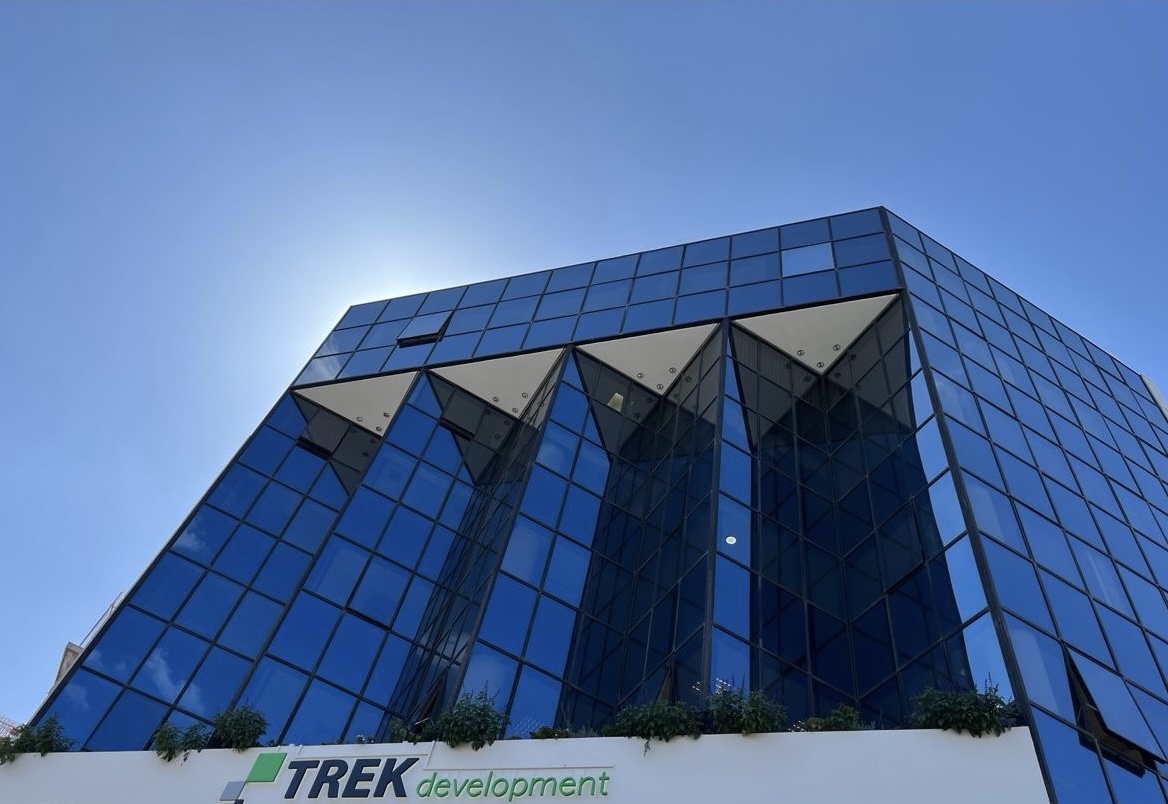
TREK is evolving into one of the most compelling small listed companies in the Greek market.
This is mainly because it meets key investment criteria such as excellent management, strong execution capability, and a clear strategic direction — qualities that are relatively rare among companies of this size.
Naturally, there are certain stock market limitations, such as its still-small market capitalization and moderate liquidity due to its listing on the EN.A. (Alternative Market). Nevertheless, its financial performance, high growth rates, and resilient stock price behavior have not gone unnoticed.
Two of the company’s most distinctive characteristics are, firstly, its consistency in turning announcements into actual financial results. Management, led by Papapolyzos, appears particularly careful in the way it communicates with the market, avoiding exaggeration while consistently delivering results above its own targets. Secondly, there is the company’s vertically integrated business model, which differentiates TREK from many small construction or consulting firms.
This means that the company does not operate merely as a contractor or consultant, but rather as a project manager, undertaking projects from conception and financing all the way to implementation and operation. Moreover, its focus on specialized sectors such as smart water management, energy efficiency, and desalination creates higher margins and significantly greater added value.
The 2025 results confirm that the company is firmly on a growth trajectory.
For 2025, sales increased by 28.7% to €3.81 million, while EBITDA surged by 111% to €1.78 million. Even more impressive was the 117.6% increase in pre-tax profits, which reached €1.65 million.
These figures become even more significant considering that the company operates without debt, while cash reserves soared to €4.29 million from just €571 thousand a year earlier.
It is also worth noting that TREK’s growth is likely not cyclical or temporary but rather supported by long-term structural trends. This is particularly important given the company’s relative independence from the Recovery Fund, unlike a large portion of the sector, as its projects are primarily funded directly through European mechanisms and institutions.
Furthermore, it is widely acknowledged that the European Union’s post-2028 policy priorities are expected to place even greater emphasis on energy, environmental sustainability, and water infrastructure — precisely the sectors where the company has strategically positioned itself for years.
Another highly positive factor is the company’s backlog. Signed contracts are estimated at approximately €8 million, while projects close to award bring the total pipeline to around €18.5 million. Given the company’s current momentum, this figure is expected to multiply over time.
For a company with annual sales of €3.8 million, this creates exceptional revenue visibility for the next two years.
As a result, management’s guidance for an additional 25%-30% increase in revenue and 15%-25% growth in net profits in 2026 — excluding any potential acquisitions — appears justified.
This leads to perhaps the most interesting aspect of the investment story. TREK appears to be gradually transforming from a small niche company into a consolidation platform for specialized activities.
Management is already in discussions with four companies regarding acquisitions and has clearly stated that it aims to complete at least two deals during 2026. Importantly, this strategy does not appear opportunistic. The company possesses strong liquidity, zero debt, and a clear focus on synergies surrounding energy efficiency, infrastructure services, and project development. Essentially, the market is being asked to value not only the company’s current size, but also the possibility of a significantly larger enterprise in the coming years.
Finally, the presence of strong institutional investors and well-known business figures in the shareholder base — such as Optima Bank, Alpha Trust, 3K, Michalis Sallas, and Theodoros Fessas — also serves as a significant vote of confidence in management. In addition, the company’s target of transferring to the Main Market within the next two years does not appear unrealistic, nor does the prospect of a strong upward trajectory for the stock.
From a valuation perspective, the picture is particularly interesting.
TREK is not “cheap” if evaluated solely on its historical 2025 figures, but it becomes considerably more attractive when incorporating the visible growth expected in 2026 and the possibility of acquisitions. After all, stocks with genuine value rarely appear undervalued and typically trade at a premium.
With net cash of approximately €4.3 million, enterprise value stands near €19.7 million. Given EBITDA of roughly €1.78 million, the EV/EBITDA multiple currently stands at approximately 11x.
This multiple may appear demanding for a small company listed on the Alternative Market, but it is not excessive considering EBITDA grew by 111%, while management guides for an additional 25%-30% increase in revenue and 15%-25% growth in profits during 2026, excluding any acquisition contribution.
Based on 2025 net profits of approximately €1.31 million, the stock trades at around 18x earnings. However, if profits increase toward €1.6 million in 2026, the forward P/E falls closer to 15x. Should successful acquisitions push profits toward or above €2 million over the next two years, the multiple could decline to roughly 12x — a very reasonable level for a company with high growth, zero debt, and a specialized position in energy, water, and critical infrastructure markets.
The P/BV ratio also appears elevated at approximately 5x book value. However, this is common among service and project development companies with limited fixed assets, where the real value lies in human capital, expertise, relationships with European institutions, and project backlog.
Under the base-case scenario, the company achieves management’s 2026 targets, continues growing organically in both revenue and profitability, and completes at least one acquisition with operational synergies. Strong liquidity, zero debt, and the expanding backlog improve earnings visibility for the coming years, allowing for a gradual re-rating of the stock.
In this scenario, valuation could rise toward €35 million, corresponding to a target price of approximately €4.73 per share, representing roughly 46% upside.
In the upside scenario, TREK ceases to be valued as a small Alternative Market company and instead becomes a specialized infrastructure and project development platform with a strong presence in energy, water, smart infrastructure, and critical public infrastructure.
The successful completion of two acquisitions during 2026, combined with strong organic growth and an expanding backlog, could drive EBITDA toward €3–3.5 million over the next two years. At the same time, a potential transfer to the Main Market would significantly improve visibility and attract additional institutional investors.
In such an environment, the market could reasonably assign TREK a forward EV/EBITDA multiple of 14x–15x, appropriate for a company with such high growth and no leverage.
This would imply a valuation near €55 million and a target price of approximately €7.35 per share — around 127% higher than current levels.
In the conservative scenario, acquisitions are delayed or proceed at a slower pace, while organic growth continues without meaningful acceleration. Simultaneously, the market continues to value TREK as a small EN.A.-listed company, maintaining a significant discount due to limited liquidity, small capitalization, and execution risk.
If profitability growth slows and investors stop pricing in aggressive expansion through acquisitions, valuation could compress materially lower. In this case, fair valuation would stand near €18 million, implying a target price of approximately €2.43 per share — around 25% below current levels.
That said, it should again be emphasized that TREK trades on the EN.A.(alternative market). This is not necessarily negative; on the contrary, it suggests that management prefers to move carefully and methodically, while many investors remember other Greek market success stories that began there as well.
For now, however, building a position requires careful handling through gradual and measured purchases, but above all, the conviction that this is a long-term investment. Despite the increased probability of strong performance, it remains a story that requires patience from those willing to believe in it.
Symeon Mavroudis, LLM, MSc Mutual Fund / Portfolio Manager
