
Its entry into port infrastructure, the acquisition of TERRA Advisory and expansion into new markets are shaping a different TREK.
A strong cash position allows management to accelerate growth, while new contracts open up prospects for larger and more diversified profitability.
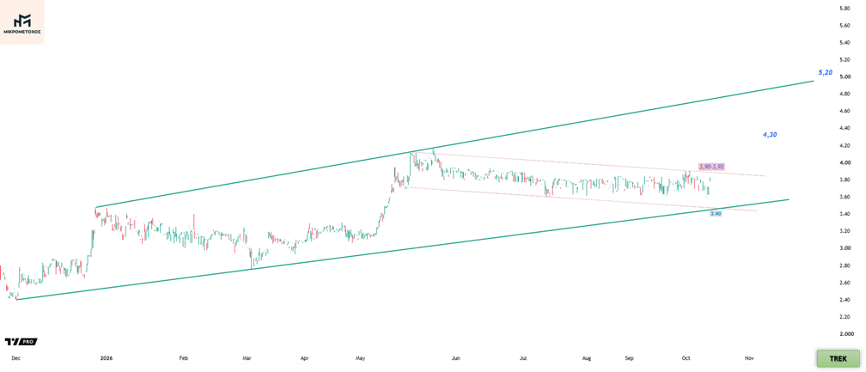
On the trading board, even though the stock is flirting with its all-time highs, it seems to have an “appetite” for new adventures in uncharted waters, and to reward those who believe in it.
To begin with, TREK Development is one of the most interesting cases among the small listed companies on the Greek stock exchange, and its investment story is gradually gaining depth.
The management of Konstantinos Papapolyzos is implementing a strategy of building a diversified group in project development and specialised services, with a presence in markets characterised by significant, long-term investment needs.
The importance of the company’s recent business moves lies mainly in the vertical integration of its model, as it broadens its capabilities from design and financing through to construction, implementation and project management.
First, its recent entry into critical port infrastructure is a substantial step toward diversifying its activities. Taking on the project for floating breakwaters and piers at the Port of Lavrio, with a total budget of €3.3 million, marks TREK’s entry into a new market.
The company’s share amounts to €1.8 million, equivalent to almost 47% of its total 2025 turnover. The contract therefore carries real financial weight for a listed company of this size, and completion is expected within the first two months of 2027.
The cooperation with the international company Marinetek, which has specialised expertise in building floating marinas and port facilities, is also considered significant.
The agreement provides for the integrated development and promotion of port and marina projects in Greece and Cyprus, covering design, financing and construction.
The Lavrio contract could therefore be the starting point for a wider line of business, with prospects for a larger backlog and a broader client base. The future value of the partnership will depend on securing additional projects and on how efficiently they are executed.
At the same time, TREK has been awarded an urban street-lighting project in the Municipality of Pylaia-Chortiatis, with a budget of €195,000. Although financially smaller, it strengthens the company’s presence in public infrastructure and energy-efficiency technologies, which are a core part of its business strategy.
In addition, the acquisition of TERRA Advisory a few months ago has added a new profitable pillar, setting the stage for an immediate increase in consolidated figures.
To that end, TREK acquired 51.23% of the company, securing control, and holds an option to acquire a further 30%, with the progress of the deal linked to meeting specific financial targets.
It should be noted that TERRA provides specialised advisory services to agri-food businesses, covering the development, organisation and modernisation of production, as well as the use of national and European funding instruments.
In 2025 it posted turnover of €2.06 million and profit before tax of €515 thousand, a pre-tax margin of about 25%.
These figures are particularly significant because the company is already solidly profitable and can help diversify the group’s revenue.
The price is also of interest. The initial acquisition was based on a valuation of €900 thousand for the whole of TERRA, while its 2025 profit before tax exceeded half a million.
The ratio of valuation to historical profitability appears particularly attractive, provided the financials are sustained. However, the deal includes possible additional payments linked to future performance, which must be factored into the final assessment of the investment.
The acquisition offers a second advantage as well. It strengthens TREK’s presence in the private sector, creating greater diversification of clients, activities and revenue sources.
In terms of financial results, TREK’s main advantage remains its strong balance sheet and the financial flexibility it has to support the next stage of its growth.
At the end of June 2026, consolidated equity stood at €4.62 million, while cash and cash equivalents were close to €2.97 million.
With bank borrowing of just €300 thousand, the company had a net cash position of about €2.67 million, giving it ample room to fund new projects and selective acquisitions.
Liquidity ratios also remain very positive. The current ratio stands at 3.4x, while net debt to equity remains negative, reflecting the absence of any meaningful financial leverage.
This picture becomes more significant as TREK moves into activities with higher execution and working-capital requirements.
Strong liquidity allows the company to bid for larger contracts, fund the early development of projects and seize business opportunities without relying excessively on bank financing.
At the same time, management continues its policy of returning capital to shareholders, having distributed a dividend of about €500 thousand. The ability to combine organic growth, acquisitions and dividend payouts is a positive feature for a company of this size.
On cash flows, the first half was marked by higher working-capital needs, with operating cash flow coming in marginally negative at about €4 thousand.
This is mainly due to the increase in receivables and inventories, as well as timing differences between project execution, invoicing and collection.
Maintaining substantial cash reserves limits immediate financing pressure, while the collection of receivables and the completion of new contracts can improve operating cash flows in the coming period.
At the earnings level, the first half of 2026 was more transitional and stabilising in nature, as TREK is in the process of broadening its business model.
Consolidated sales came to €1.87 million, compared with €1.90 million in the same period last year, essentially flat.
Gross profit fell to €924 thousand from €1.26 million, while profit before tax came to €531 thousand, compared with €951 thousand. Net profit amounted to €414 thousand.
This reflects higher spending on strengthening the company’s organisation and operations, as well as the timing of project execution and revenue recognition.
Moreover, TERRA Advisory was consolidated into the financial statements only from the end of May, so its contribution covers just a limited period.
In essence, TREK is in a phase in which its operating model is adapting to a larger business scale, while the new contracts and acquisitions have not yet been fully reflected in profitability.
The second half is therefore expected to be the real test of the transformation, as it will show to what extent the strong capital base, the expanded scope of activities and the new partnerships can be converted into higher recurring profits and meaningful cash generation.
Management estimates that the parent company will report sales of over €6 million and profit before tax of close to €2 million for full-year 2026, while at group level it expects additional revenue of about €1 million and profit before tax of €300 thousand from TERRA.
If the targets are met, TREK will show a substantial acceleration in growth. For this to happen, a particularly strong second half is required, since a significant part of the projected sales and profits had not yet been recorded by June.
On valuation, with a market capitalisation of about €30 million and after deducting the half-year net cash position, enterprise value comes to roughly €27.4 million.
Based on 2025 EBITDA of about €1.78 million, the EV/EBITDA ratio is close to 15.4x. The P/E, based on 2025 net profit of about €1.31 million, is approaching 23x, while P/BV is close to 6.5x. These multiples price in substantial future growth, without being considered prohibitive going forward, given the increased likelihood that results will “step up to a new level,” significantly reducing these multiples.
For example, if consolidated after-tax profit approaches €1.7 million in 2026, the forward P/E falls to around 18x, under the “simple” and by no means unlikely assumption that management’s forecasts are met.
Interest therefore shifts to 2027 performance, when the acquisition will contribute on a full twelve-month basis and the new contracts will begin to have a greater impact on results.
In the base case, TREK meets its 2026 targets and continues to grow organically, with EBITDA potentially reaching €2.6 million in 2027. With an EV/EBITDA multiple of 12x and net cash at roughly current levels, the valuation could be around €34 million, equivalent to about €4.30 per share and 13% upside from the current price.
In the optimistic scenario, the partnership with Marinetek leads to more contracts, TERRA substantially boosts results and TREK achieves further vertical integration. With EBITDA of about €3.5 million and an EV/EBITDA multiple of 14x, the potential valuation could approach €52 million, or about €6.60 per share, offering potential upside of 75%.
In the conservative scenario, delays in project execution continue, profit growth falls short of expectations and the market reduces the premium it assigns to the company. With EBITDA of about €1.7 million and an EV/EBITDA multiple of around 9.5x, the valuation could be close to €19 million, or about €2.40 per share, implying a potential decline of 37% from current levels.
It is worth noting that the stock was listed last year, in mid-November 2025, at an IPO price of €1.40, and has since gained 170%.
As a result, nobody has any complaints about the stock, in a double sense: on the one hand, there are no trapped holders who could become potential sellers and hold back further gains; on the other, those who believed in Papapolyzos’s team have so far been rewarded for their trust with outsized returns, and may well continue to follow the stock without hesitation, even to new highs.
